
More Than Church Management: How Faith Links Brings Your Church Operations Together
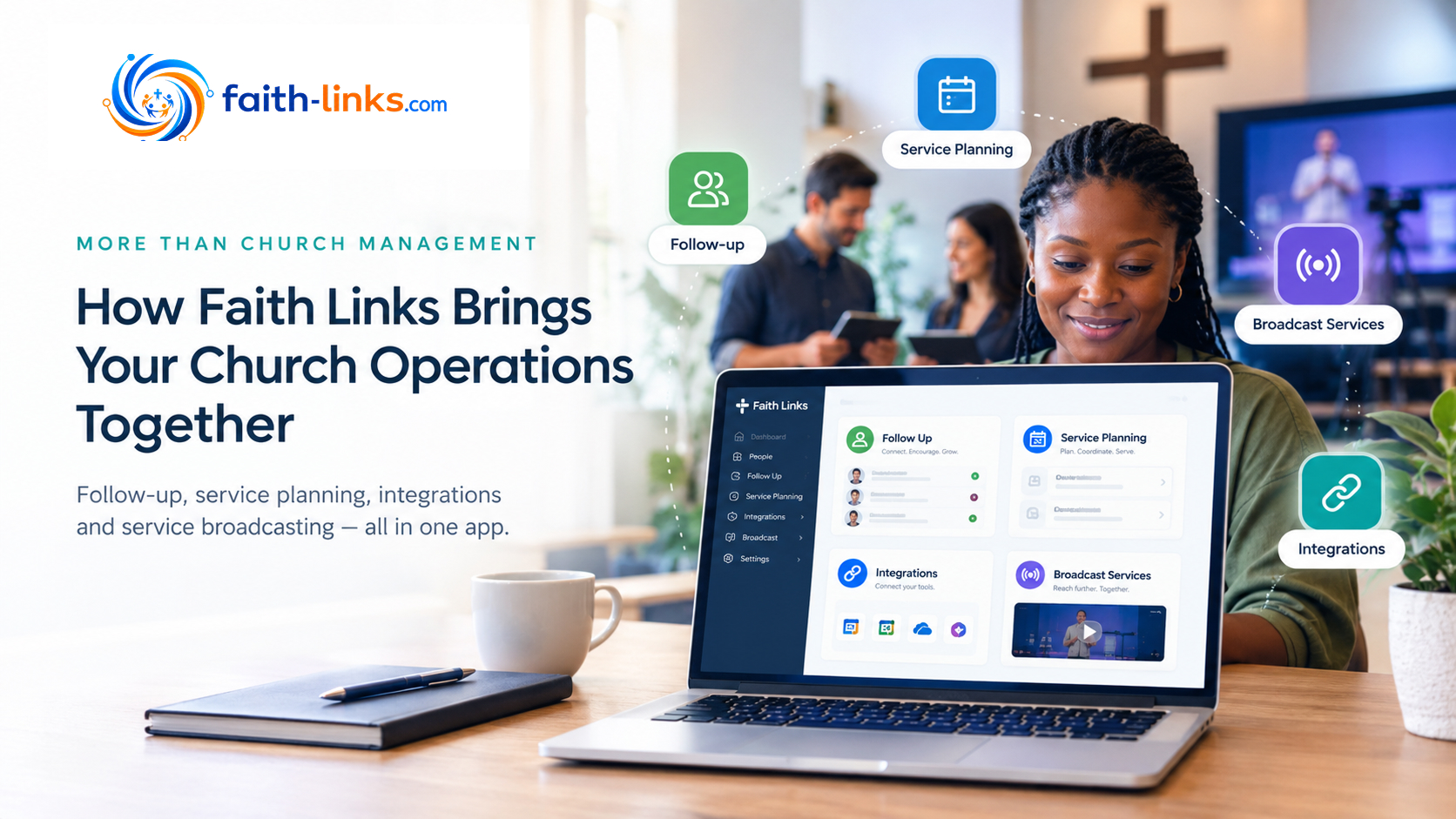
Running a church involves much more than organising Sunday services. Behind every service, programme, and ministry activity is a series of tasks that require planning, coordination, communication, and follow-up.
From welcoming new visitors and following up with members to planning services, coordinating church activities, connecting digital tools, and broadcasting services, church teams have a lot to manage.
Unfortunately, many churches rely on different applications to handle these responsibilities. One tool may manage membership records, another may support service planning, while other activities are handled through spreadsheets, messaging platforms, or manual processes.
The result? Fragmented information, unnecessary complexity, and more work for church administrators.
Faith Links takes a different approach by bringing essential church management functionalities together in one app.
The Challenge With Using Multiple Church Management Apps
Church administration becomes more complicated when different activities are managed through disconnected systems.
Consider a church that uses one platform to manage members, another to plan services, and separate tools for broadcasting and communication. Administrators may have to switch between applications, maintain information in multiple places, and coordinate activities manually.
This approach can create several challenges:
-
Disconnected information: Important details may be scattered across different platforms.
-
Time-consuming administration: Teams spend more time switching between tools and managing repetitive tasks.
-
Inconsistent follow-up: New visitors and members may not receive timely communication when follow-up processes are poorly coordinated.
-
Complex service planning: Coordinating people, programmes, and service activities can become unnecessarily difficult.
-
Additional operational complexity: Managing multiple applications can make training, access management, and daily administration more demanding.
Churches need more than individual digital tools. They need a coordinated way to manage the different activities that keep their operations running.
Faith Links: One App, Multiple Church Management Functions
Faith Links is designed around the idea that church administration should be connected, organised, and easier to manage.
Rather than focusing on only one or two administrative functions, Faith Links brings together key areas of church operations in one app.
Here are four important areas that make the platform stand out.
1. Follow-Up: Help Ensure People Don't Fall Through the Cracks
Connecting with people is an important part of church life. Whether someone is visiting for the first time, joining a programme, or requiring further communication, consistent follow-up helps churches build meaningful relationships.
Without a structured process, follow-up activities can easily be overlooked, particularly when responsibilities are shared among different ministry teams.
Faith Links' follow-up functionality is intended to help churches organise this important aspect of their operations.
With a more structured follow-up process, churches can work towards ensuring that visitors and members receive appropriate attention and that assigned responsibilities are easier to manage.
The goal is simple: help church teams stay organised while keeping people at the centre of ministry.
2. Service Planning: Prepare and Coordinate Church Services More Effectively
A successful church service requires preparation and coordination. Pastors, worship teams, media personnel, ushers, and other ministry workers may all have responsibilities to fulfil before a service begins.
When planning happens across disconnected messages, documents, and conversations, it can be difficult to keep everyone aligned.
Faith Links includes service planning as part of its broader church management approach, helping churches organise service-related activities more systematically.
Instead of treating service planning as an isolated task, churches can make it part of a more coordinated administrative workflow.
This can help ministry teams prepare with greater clarity and reduce avoidable confusion during service preparation.
3. Integrations: Bring Your Church's Digital Activities Together
Churches increasingly depend on digital tools to support their daily operations. However, managing multiple tools independently can introduce unnecessary friction.
Integrations can help connect compatible systems and reduce the need to manage every activity separately.
Faith Links' integration offering forms part of its all-in-one approach, helping churches work towards a more connected digital environment.
The value of integrations lies in reducing fragmentation and making technology more useful to the people who depend on it.
The specific integrations available will depend on the services supported by Faith Links.
4. Broadcast Services: Extend the Reach of Your Church Services
Church services are no longer limited to the people physically present in a church building. Members may be travelling, living in other locations, or unable to attend in person.
Broadcasting services provides an opportunity to reach these audiences digitally and make church programmes more accessible.
With service broadcasting included in its broader range of functionalities, Faith Links aims to help churches bring this activity into their digital church management environment.
This means churches can consider service broadcasting as part of their wider operational setup rather than treating every digital activity as a completely separate responsibility.
What Makes Faith Links Different From Other Church Management Apps?
Many church management solutions concentrate on specific areas of administration. Some focus primarily on membership records, while others emphasise particular operational needs.
Faith Links' central proposition is different: an all-in-one approach to church management.
Its value lies in bringing multiple important functions into one platform, helping churches reduce their dependence on disconnected tools.
|
Church need |
How Faith Links addresses it |
|---|---|
|
Follow-up |
Provides a dedicated functionality for organising follow-up activities |
|
Service planning |
Supports the planning and coordination of church services |
|
Integrations |
Supports a more connected digital workflow through compatible integrations |
|
Service broadcasting |
Includes broadcasting as part of its broader church management offering |
The benefit is not simply having more features. It is having a more unified approach to managing the activities that support church operations.
For pastors, administrators, and ministry teams, this offers an opportunity to simplify workflows and create a more organised administrative environment.
Who Can Benefit From Faith Links?
Faith Links is designed for churches that want a more structured approach to managing their operations.
It may be particularly relevant to:
-
Pastors and church leaders who want better visibility into church activities.
-
Church administrators responsible for coordinating records and administrative tasks.
-
Ministry coordinators who need to organise service planning and related responsibilities.
-
Follow-up teams that need a more structured way to manage communication with visitors and members.
-
Church media teams involved in broadcasting services and supporting digital activities.
Whether a church is looking to improve existing processes or move away from managing everything through separate tools, an all-in-one platform can be worth considering.
A More Connected Approach to Church Management
Church administration should support ministry, not make it unnecessarily complicated.
When essential activities are scattered across multiple systems, teams can spend valuable time managing tools instead of focusing on their responsibilities.
Faith Links brings together follow-up, service planning, integrations, and service broadcasting within an all-in-one church management proposition.
By consolidating these functions, the platform aims to help churches create a more organised, coordinated, and manageable digital environment.
Technology cannot replace spiritual leadership, personal relationships, or the work of ministry. But the right technology can help church teams manage their responsibilities more effectively.
Ready to explore a more complete approach to church management?
Visit Faith Links to discover how one app can support more of your church's everyday operations.